Reference guide
Multilingual restaurant menus: choose and maintain languages
A useful multilingual menu first translates what guests need to choose: sections, descriptions, relevant ingredients, allergens and offer details. Start with languages guests actually request, define a shared glossary and update every active version after a product or price change.
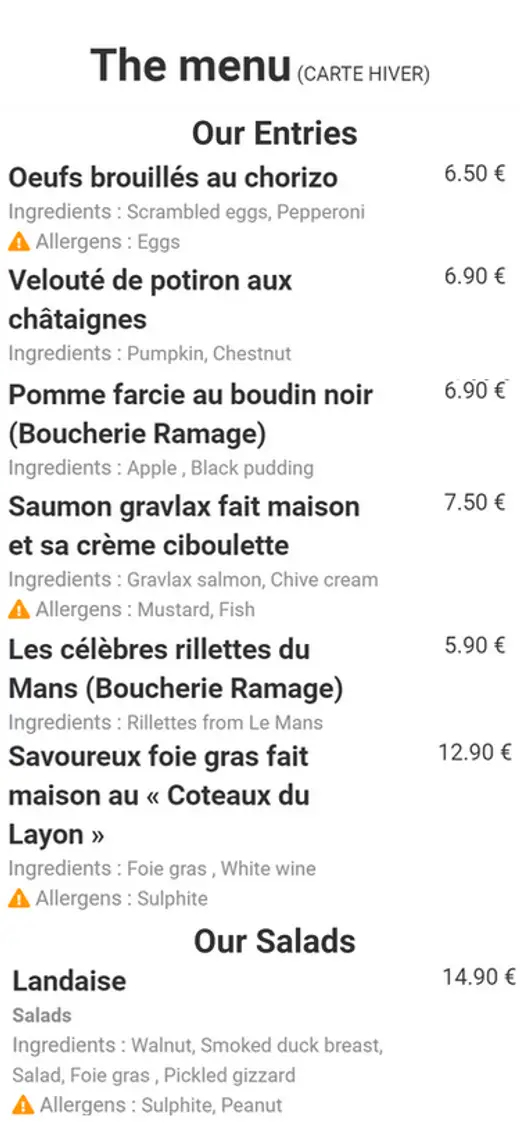
Translate a few dishes right away
To see what an accurate translation actually looks like on your own wording, the free restaurant-menu translator handles up to fifteen dishes, translating them from French into nine different languages, without an account and without keeping any of your data.
This guide deals with the question that comes next, and it is the only genuinely difficult one: choosing the right languages, and keeping every version up to date as the menu itself changes.
How should languages be selected?
Pay attention to the questions guests actually put to your staff, the languages spoken by the groups you welcome, and the tourist season. One well-maintained English menu brings more clarity than several incomplete versions in other languages.
In SimplyRestau, French is available on the Free plan, English on Essential, and up to 50 languages on Pro. This split needs to be compared against what the venue actually needs.
What should be translated first?
- Sections: translate them, so that guests can find their way around the menu.
- Descriptions: translate the genuinely useful information, so guests understand composition and preparation.
- Allergens: use reliable, consistent terms throughout, to avoid any ambiguity.
- A signature dish name: keep the name as it is, then explain it, to preserve the dish's identity.
- Prices: keep exactly the same value, to avoid any discrepancy between languages.
How can versions stay aligned?
When a dish is edited in SimplyRestau, the editorial check needs to cover every published language. The mere presence of a multilingual interface does not, on its own, guarantee the quality of the text.
- Stabilise the French record before starting any translation.
- Build a glossary of sections, cooking methods and other recurring terms.
- Have sensitive passages reviewed by someone genuinely competent in the target language.
- Publish every affected version within the same publication cycle.
- Check a sample of products from the guest's own phone.
How should common English difficulties be handled?
- Describe the dish rather than translate a culturally specific name word for word.
- Specify the cooking method whenever it actually affects the guest's choice.
- Use exactly the same term every time for a recurring ingredient.
- Avoid claims such as 'allergen-free' unless you have a process able to genuinely guarantee them.
- Proofread numbers, units and prices separately from the surrounding text.
What checklist should be used before publishing?
- Every visible section actually exists in each language announced to guests.
- No old price is left lingering in any translation.
- Allergens remain correctly attached to the right products.
- The links and buttons used to switch language work correctly on mobile.
- Someone knows exactly how to report and correct a translation.
Frequently asked questions
Do the names of every dish need to be translated?
No. A proper or regional name can be kept as it is and paired with a clear description in the guest's own language.
Is a machine translation good enough on its own?
It can help prepare a first draft, but culinary terms, allergens and any ambiguous wording still need to be reviewed carefully before publication.
Sources and review
Try SimplyRestau with your own menu
Start with a free menu and check the mobile result before choosing a plan.